




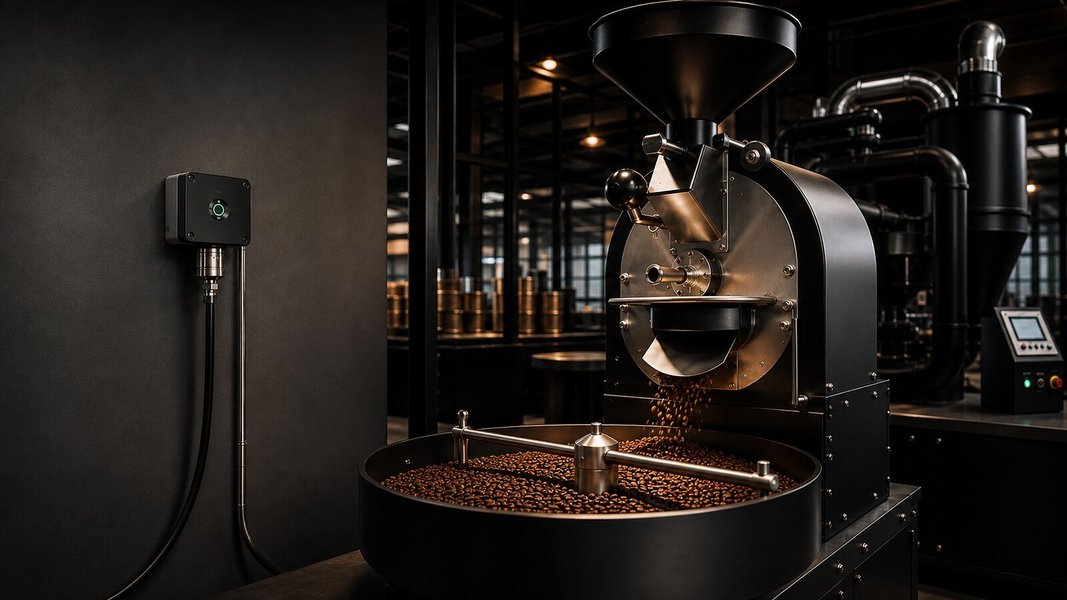
Freshly roasted coffee releases CO₂ for hours and days. In silos, big bags, storage rooms or low-lying areas, this odorless gas can accumulate and displace oxygen. Roasting itself also produces carbon monoxide (CO) - toxic, flammable and likewise impossible to detect with the senses. Combined with heat, dust and process air, this creates an environment in which gas detection technology is more than a formal safety measure.
The coffee example may initially seem highly specific. In fact, it represents a broader industrial pattern: Wherever organic materials are processed, fermented, roasted, cooled or stored, invisible gas risks can arise. A suitable gas detector measures what people cannot smell, see or taste - before a deviation becomes a hazard.
How Coffee Becomes a Gas Risk
Coffee does not become completely inert once roasting is finished. Freshly roasted beans release CO₂ - which is why many coffee packages have a degassing valve. What is designed to escape safely from a bag can become a problem in large quantities: In big bags, silos or poorly ventilated storage areas, CO₂ tends to accumulate near the floor, in pits, corners and low-lying rooms.
Carbon monoxide is also produced during roasting. CO is highly toxic, binds to hemoglobin and can become dangerous even at relatively low concentrations. At the same time, coffee dust and chaff dust can form ignitable mixtures with air. Roasteries therefore have to address several safety issues at once: gas monitoring, ventilation, occupational safety and explosion protection.

When Businesses Need Gas Detection Technology
Businesses need a gas detection system whenever hazardous or process-critical gases may be generated, used, stored or released. This applies not only to chemical plants, semiconductor manufacturing or biogas facilities, but also to breweries, wineries, dairies, commercial kitchens, cold stores, packaging lines - and coffee roasteries.
The key question is not simply whether a gas is present. What matters is what happens if it escapes uncontrollably or accumulates locally. CO₂ can displace oxygen, CO can poison people, and flammable gases or dust-air mixtures can create an explosive atmosphere. A gas detector does not replace a risk assessment. It is the technical response to that assessment.

What a Gas Detector Really Needs to Deliver
A gas detector is only as good as its suitability for the specific application. Flammable gases, toxic gases and oxygen deficiency place different demands on the sensor principle, measuring range, response time and alarm strategy. Environmental factors such as temperature, humidity, dust, pressure, air flows and potential cross-sensitivities must also be considered.
In a roastery, sensor technology must cope with heat, dust, varying CO and CO₂ levels, and cleaning processes. A data sheet alone is therefore not enough. The central question is: Will this sensor technology operate reliably under real conditions over time - repeatably, with low drift and with a maintenance concept that remains practical in day-to-day operations?

Explosion Protection and Gas Detection: Two Topics, One System Approach
Explosion protection and gas detection are more closely connected than they may initially appear. Where flammable gases, vapors or dusts may occur, ventilation alone is not always sufficient to reliably prevent a hazardous atmosphere. Gas detection continuously monitors whether concentrations are approaching critical limits - long before a dangerous situation develops.
In practice, this means providing an early warning, automatically increasing ventilation, shutting down ignition sources, stopping processes or notifying the control room. Whether the hazard is a solvent at a packaging line, methane in biogas processing or CO around a roasting machine, gas detection contributes to explosion protection before the critical point is reached.
Selection, Placement and Maintenance Determine Effectiveness
Selecting a gas detection system begins with identifying the relevant gases. The next considerations are the measuring range, sensor principle, response time, environmental conditions, alarm thresholds and integration into existing systems. Is a local alarm sufficient, or must the gas detection system control ventilation, shutdown systems, building management systems, the control room or a PLC?
The placement of measuring points is equally important. CO₂ is heavier than air and often accumulates in lower areas. Other gases rise or disperse with air currents. Exhaust systems, heat from machinery, open doors, structural obstacles and process air all influence where a sensor can provide meaningful measurements.
Maintenance also determines the quality of a gas detection system. Sensors age, become contaminated and may drift. Measuring points must be accessible, inspection intervals must be realistic, and calibrations must be feasible and reliable. A system that is technically well selected but difficult to maintain in everyday operation can quickly become a risk itself.

Gas Detection Systems in the Food Industry
Gas detection systems have long formed part of many safety concepts in the food industry, often without attracting much attention in day-to-day operations. CO₂ is produced during fermentation in breweries and wineries, used to carbonate beverages, and used to create a protective atmosphere in packaging lines. Refrigeration systems use ammonia (NH₃), CO₂ or other refrigerants.
The risks are similar across sectors: oxygen displacement in cellars, tanks and pits; toxic or flammable components; process-critical deviations; and stresses caused by cleaning and temperature. A gas detection system in the food industry must therefore be robust, suitable for hygienic integration and precise enough to provide an early warning.

smartGAS: Sensor Technology for Real Industrial Conditions
smartGAS has been developing gas measurement technology for industrial applications for more than 20 years. The focus is on sensor technology that not only performs well in the laboratory, but also operates reliably in real plants - under changing conditions, with different gases and with clear requirements for integration, operation and maintenance.
Anyone planning a gas detection system or looking to improve existing gas monitoring should clarify the following points at an early stage:
- Which gases are relevant - toxic, flammable, oxygen-displacing or process-critical?
- Where do risks arise, and where can gases accumulate?
- Which measuring ranges, response times and alarm thresholds are required?
- Which interfaces must the gas detection system support?
- How will the system remain easy to test, calibrate and maintain over the long term?
If you are planning a gas detection system or want to improve your existing gas monitoring, smartGAS can support you in selecting suitable sensor technology, measuring points and alarm strategies - technically sound, practical and without unnecessary complexity.
FAQ
What Is a Gas Detector, and When Is One Needed?
A gas detector identifies specific gases and issues a warning when critical concentrations are reached or defined alarm thresholds are exceeded. It is useful wherever flammable, toxic, oxygen-displacing or process-critical gases may occur. The risk assessment for the relevant facility remains the basis for its use.
Why Is Coffee a Good Example of Gas Risks?
Freshly roasted coffee releases CO₂, roasting can produce CO, and fine coffee dust or chaff dust can be ignitable. Roasteries therefore provide a clear example of how invisible gas risks can also arise in food production - not only in conventional chemical or energy facilities.
How Are Explosion Protection and Gas Detection Connected?
Where flammable gases, vapors or dusts may occur, gas detection continuously monitors critical concentrations and enables countermeasures before hazardous atmospheres develop. These measures include ventilation, shutdown, alarms or stopping the process.
What Is the Difference Between a Fixed Gas Detection System and a Portable Gas Detector?
A portable gas detector protects people during specific tasks, such as maintenance or inspection work. A fixed gas detection system continuously monitors defined areas and can trigger alarms or technical protective measures. In many facilities, combining both approaches is the most effective solution.